The End of the Extractive Cloud: Inside the $129,999 “City-in-a-Box” Revolution
1. The Fragility of the “Macro-Internet”
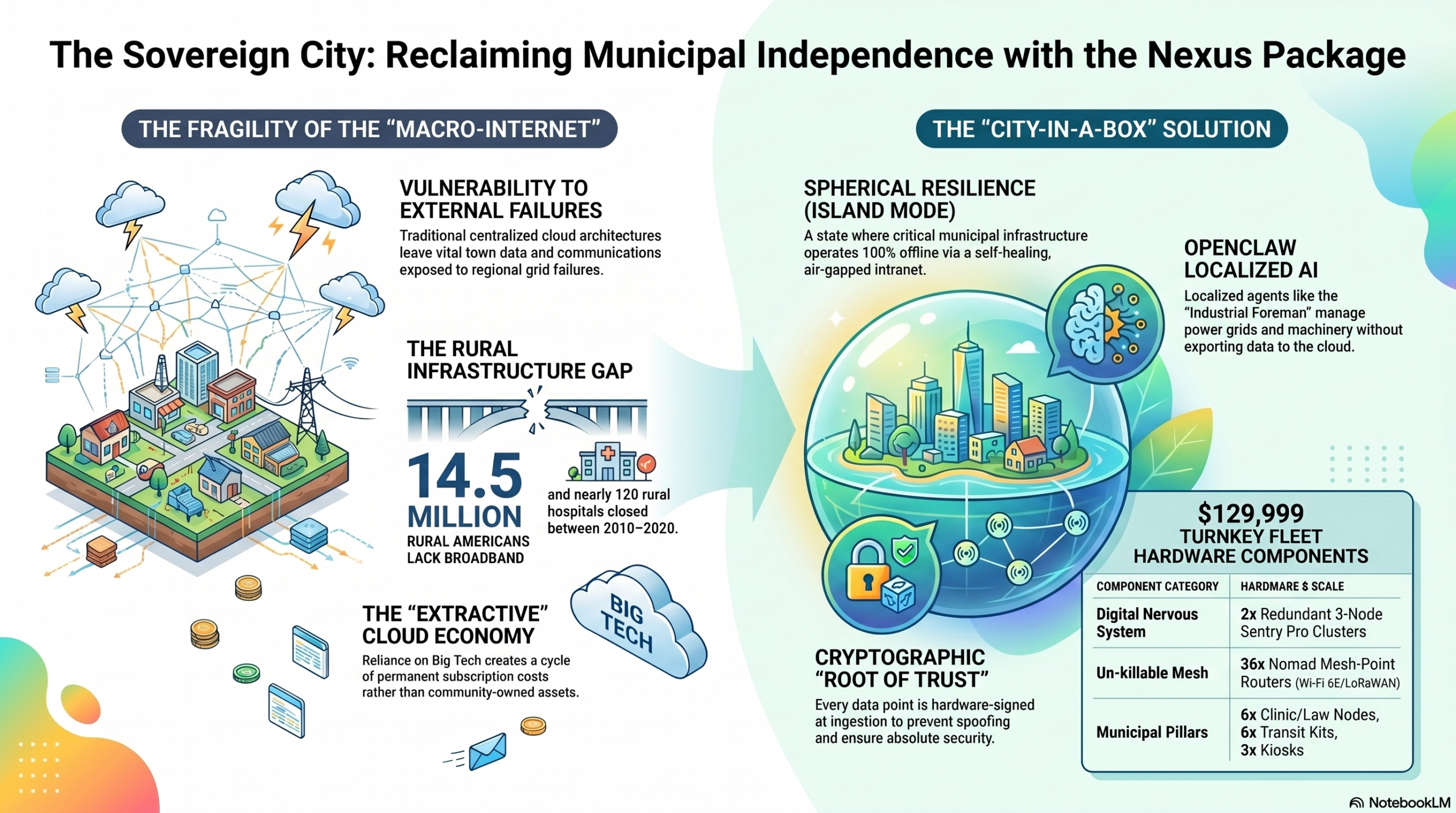
For decades, the digital lifeblood of small-town America has been pumped in from afar. We are currently witnessing the terminal limit of centralized hyperscale logic, where municipal records, emergency dispatch, and utility management are held hostage in remote, “extractive” data centers. This reliance on the macro-internet has created a profound structural fragility: when a regional grid fails or a cloud provider experiences an outage, the town’s essential services effectively cease to exist.
This vulnerability arrives as the stakes for local infrastructure reach a fever pitch. We are in the midst of a “Rural Rebound”—a demographic resurgence that saw 670,000 domestic migrants flood into rural areas between 2021 and 2024. As professionals flee the urban core, the demand for resilient municipal services has surged. DeReticular, the AI research powerhouse founded in 2020, is answering this call by offering “Island Mode” resilience—a state of “Spherical Resilience” that allows a community to remain a fully operational “digital nervous system” even when severed from the global grid.
2. The $129,999 “City-in-a-Box”
The tip of the spear in this movement is a single, palletized SKU: SOV-BNDL-CITY, the “City Infrastructure” Nexus Package. For a turnkey price of $129,999, DeReticular delivers a sovereign, autonomous city operating system designed for towns of 1,000 to 3,000 residents. This isn’t just hardware; it is a fundamental shift from “renting” cloud logic to “owning” a permanent community asset.
The package arrives in eight heavy-duty, weather-sealed transit crates, containing a fleet of pre-provisioned, ruggedized hardware:
- 2 High-Capacity Sentry Pro Clusters: Six total 1U nodes serving as the redundant core, deployed in active-active redundancy between City Hall and Police HQ.
- 36 Nomad Mesh-Point Routers: Ruggedized Wi-Fi 6E/LoRaWAN units that blanket the city grid in an un-killable, decentralized intranet canopy.
- 6 Nomad Fleet Kits: Mobile edge “transit brains” that integrate into municipal shuttles via CAN Bus for autonomous dispatch and load balancing.
- 6 Sovereign Sentry Nodes: Dedicated professional hardware—four for HIPAA-compliant medical clinics and two for attorney-client privileged law offices.
- 3 Municipal Kiosks: Ruggedized outdoor interfaces that serve as public-facing LLM concierges and LiDAR-based security sentries.
3. Achieving “Island Mode” through Spherical Resilience
“Island Mode” is the core philosophy of the DeReticular ecosystem—the ability for a city to retreat into a self-sustaining digital shell. As DeReticular’s strategic directives state:
“Localized communities must end their reliance on vulnerable ‘macro-internet’ cloud providers… allowing municipal and industrial networks to operate autonomously and securely even during complete grid or telecommunications failures.”
To achieve this, the Rural Infrastructure Operating System (RIOS) utilizes a “Trinity Stack” architecture. Running on Proxmox VE (a Type-1 hypervisor), each node manages three isolated virtual environments simultaneously to protect the digital border:
- The Gatekeeper (Layer 1): Utilizes pfSense to bond external connections like Starlink while maintaining a strict hardware firewall.
- The Ledger (Layer 2): An Ubuntu-based layer processing local logic, peer-to-peer storage, and the city’s unique “Root CA Minting.”
- The Auditor (Layer 3): A Kali Linux environment that acts as an internal immune system, constantly executing vulnerability scans to hunt for intrusions.
4. AI That Doesn’t Need the Internet: The OpenClaw Framework
The Nexus Package subverts the traditional AI model by running advanced agents entirely on local NVIDIA GPUs using quantized 4-bit Llama 3 models. Through the OpenClaw Framework, the city runs localized agents that handle critical, sensitive tasks without ever reaching out to a cloud API:
- The Industrial Foreman: Manages micro-grids and heavy machinery. In advanced applications, it controls the “Sovereign Forge,” monitoring thermal gradients for the 3D printing of refractory metals like tungsten for aerospace repairs.
- The Field Medic: Processes medical telemetry and manages Non-Emergency Medical Transportation (NEMT) while keeping sensitive records on an air-gapped network.
- The Sovereign Executive: A secure concierge for legal and administrative automation, from contract generation to encrypted dictation.
- The Sovereign Elector: A dedicated agent for securing and cryptographically verifying localized voting terminals, ensuring political sovereignty is as un-killable as the hardware it runs on.
5. Solving the “Oracle Problem” with Radio Fingerprints
In decentralized networks, the “Oracle Problem”—the risk of spoofed or hacked sensor data—is the primary failure point. DeReticular solves this by anchoring the city’s data to absolute, verified physical reality.
The process begins with Root CA Minting, where the system generates over 50 unique cryptographic identities for the town’s nodes. Before any data is accepted, the system uses Radio Frequency Fingerprinting to scan for microscopic manufacturing imperfections unique to the hardware’s radio signature. Once verified, data is signed at the moment of ingestion using a non-exportable private key burned into a factory-sealed TPM 2.0 chip. This creates a digital nervous system that is physically impossible to deceive from the outside.
6. From “Brain Drain” to “Human Capital Engine”
Rural communities have long been hollowed out by “Brain Drain,” but DeReticular positions its Academy as a counter-measure. This is the “Entrepreneurial Social Infrastructure” necessary for the modern age. By training local talent to maintain the RIOS platform, the town stops exporting its wealth and starts building a “machine-to-machine economy.”
We have already seen this in action with Project Octagon in La Paz County, Arizona. In an “Extreme Demand” environment, the deployment of autonomous “Kurb Kars” solved a critical NEMT crisis for an aging population. It proved that when a town owns the stack, it doesn’t just solve logistics; it creates a self-sustaining ecosystem where tech jobs and innovation remain within the city limits.
7. Conclusion: The Blueprint for a Sovereign Future
The combination of DePIN hardware, local AI, and mesh networking transforms a town from a fragile cost center into a revenue-generating, sovereign asset. As rural America faces a “natural decrease”—where deaths outnumber births—automation is no longer a luxury; it is the only way an aging population can maintain high-level infrastructure.
The “Rural Rebound” is more than a migration trend; it is a mandate for a new kind of civic architecture. By decoupling from the macro-internet, small towns are not just surviving—they are leading.
The question remains: As centralized systems become increasingly brittle, would you feel safer in a city that has the power to run entirely in “Island Mode”?