Implementation Framework: Co-Optimized Energy-Compute Sovereign Nodes
- Topological Paradigm Shift: From “The Line” to “The Node”
The strategic transition from centralized, linear transmission models (“The Line”) to decentralized, spherical Sovereign Node networks is the only viable path to overcoming the “Permitting Wall.” Tech conglomerates currently face up to five-year delays for environmental impact reviews and substation buildouts while attempting to secure gigawatts of new capacity. By pivoting to a producer-centric topology, infrastructure operators can bypass interconnection queues that now exceed 50 months. Legacy grid models are increasingly congested by non-synchronous renewable resources, creating a fragility that the Sovereign Node solves by transmitting high-value digital telemetry and carbon-negative synthetic fuels rather than raw physical electricity.
The following table evaluates the structural vulnerabilities of legacy linear systems against the spherical resilience of the Sovereign Node:
Feature Legacy Linear Topology (“The Line”) Sovereign Node Topology (“The Node”)
Failure Vulnerability High; single-point failure in generation or transmission causes cascading outages. Low; autonomous hubs provide “Spherical Resilience” against network collapse.
Interconnection Duration 50+ months (average 4.5 years); stalled by RTO backlogs. < 90 days; bypasses utility queues via off-grid “Island Mode” deployment.
Operational Autonomy Dependent on macro-grid stability and cloud connectivity. High; self-sustaining biochemical and computational loops.
Grid Interaction Subject to transmission congestion and non-synchronous resource volatility. Independent; utilizes local “negative-cost” feedstocks for baseload stability.
This paradigm shift redefines the primary unit of infrastructure from the transmission line to the high-integrity Sovereign Pod chassis.
- Physical Architecture and Dual-Chamber Topology
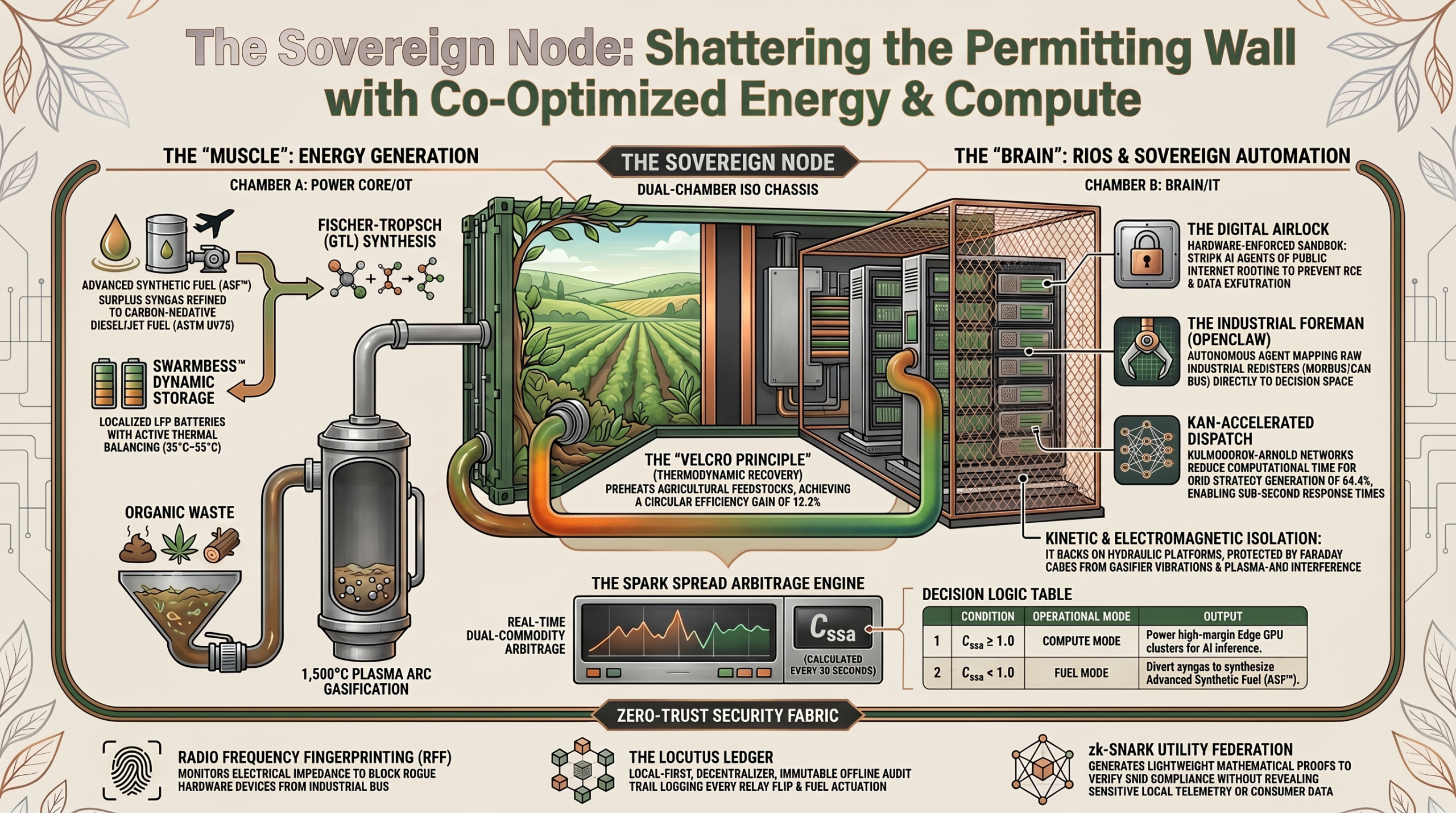
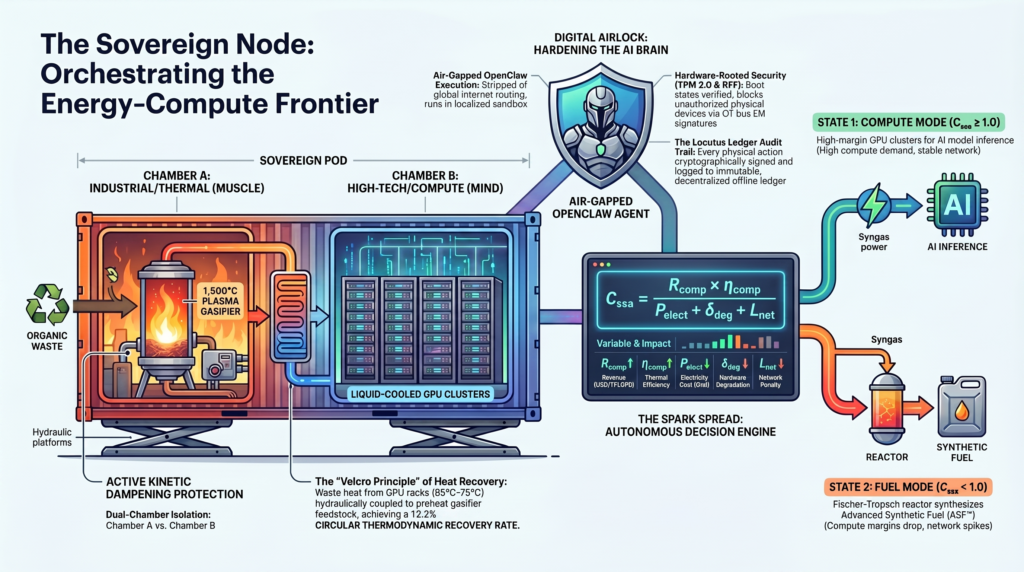
The Sovereign Pod is an ISO-standardized 40-foot shipping container designed to operate as a self-contained energy and compute refinery. Physical and thermodynamic isolation within the chassis is strategically mandated to co-locate high-heat 1,500°C plasma gasification processes with sensitive high-performance computing hardware. This dual-chamber topology prevents thermal bleeding and vibrational interference from compromising the IT zone.
The Pod’s dual-chamber layout and technical specifications are defined below:
- Chamber A (The Power Core/OT Zone): Houses high-temperature biochemical conversion systems.
- 1,500°C Plasma Arc Gasifier: Modular core processing organic agricultural waste (hemp herd, manure, wood residue) into hydrogen-rich baseload syngas.
- Fischer-Tropsch (FT) Reactor: Compact catalytic reactor for polymerizing syngas into carbon-negative Advanced Synthetic Fuel (ASF™).
- Baseload Syngas GenSet (10 MW): Provides primary localized power generation.
- SwarmBESS™ Controller: Manages LFP battery storage with active thermal balancing to maintain internal cell temperatures between 25°C and 35°C.
- Chamber B (The Brain/IT Zone): A hardened, IP65-rated environment operational from -40°C to +75°C.
- Sentry Pro Server Stack: Fanless, ruggedized 1U servers with AMD EPYC/ARM64 processors and TPU accelerators (targeting >200 TOPS/W).
- Liquid-Cooled GPU Cluster: High-density hardware for AI inference and edge-compute tasks.
- RF Shielding Cage: High-attenuation copper mesh providing >80 dB Faraday attenuation to protect electronics from plasma arc EMI.
To mitigate mechanical stress (SR-02), Chamber B racks are mounted on Active Hydraulic Kinetic Dampening Platforms that reduce displacement to <0.01 mm. These isolated chambers are reunited through a shared thermodynamic loop that optimizes the entire system’s efficiency.
- Thermodynamic Integration: The “Velcro Principle”
The “Velcro Principle” transforms waste heat from an operational liability into an efficiency multiplier, driving circular resource economics. By hydraulically coupling IT cooling loops to industrial preheating, Sovereign Nodes utilize the “muscle” of the gasifier to support the “brain” of the server stack.
The fluid-to-fluid heat exchange mechanism routes GPU coolant, exiting Chamber B at 65°C–75°C, to Chamber A for the specific purpose of drying wet organic agricultural feedstocks (such as manure and hemp herd) and preheating gasification water. This implementation targets a circular thermodynamic recovery rate of 12.2%, effectively reducing the net energy parasitic load of the fuel-conversion process. These heat loops are managed by the digital orchestration stack to maintain stability across both chambers.
- Hardened Digital Orchestration: The OpenClaw Stack
The May 2026 security crisis demonstrated the “Trusted Environment Fallacy,” where cloud-tethered agents with administrative access were compromised via remote code execution. Sovereign Automation addresses this by moving all orchestration to a hardened, edge-native framework using the OpenClaw agent stack.
The Digital Airlock deployment follows a rigorous three-step protocol:
- Network Isolation: Strip the containerized OpenClaw runtime (specifically the dereticular/openclaw-robotics:latest Docker image) of all global internet routing tables and public DNS entries.
- Cryptographic Signing: Restrict tool execution to local Model Context Protocol (MCP) skills cryptographically signed by the master root key.
- Local Logging: Commit all agentic actions to the Locutus Ledger, an immutable offline audit trail that prevents remote modification of operational history.
The “Industrial Foreman” role utilizes MCP to map Modbus TCP, RTU, and CAN bus registers directly to its action space. Agent boundaries are defined by Soul.md (communications and operational limits) and Agents.md (token budgets and resource allocation). This allows for real-time asset sensing and tool execution within a strictly bounded mathematical optimization framework.
- Algorithmic Optimization: The Spark Spread Engine
Traditional linear programming and AC-OPF solvers are computationally prohibitive for edge-native Virtual Power Plants (VPPs). The Sovereign Node utilizes the Spark Spread Engine to perform real-time, autonomous arbitrage between digital commodities (compute) and physical commodities (fuel).
The Spark Spread Arbitrage Coefficient (C_{ssa}) is calculated every 30 seconds using the following deterministic state logic:
C_{ssa} = \frac{R_{comp} \times \eta_{comp}}{P_{elect} + \delta_{deg} + L_{net}}
- R_{comp}: Revenue rate from edge-compute jobs ($/FLOPS).
- \eta_{comp}: Thermal efficiency multiplier (1.122).
- P_{elect}: Opportunity cost of electricity (grid tariff or discharge rate).
- \delta_{deg}: Hardware degradation (battery/GPU wear).
- L_{net}: Network penalty coefficient (latency/packet loss).
System State Execution:
- Compute Mode: If C_{ssa} \ge 1.0, route power to local GPU clusters.
- Fuel Mode: If C_{ssa} < 1.0, divert syngas to the FT reactor for ASF™ synthesis.
To enable sub-second Volt-VAR control, the system utilizes Kolmogorov-Arnold Networks (KAN). KAN-based dispatch reduces computational solution time by 64.4% compared to traditional solvers. We accept a 4.7% divergence from the absolute optimal physical path as a necessary trade-off for the millisecond responsiveness required for off-grid stability.
- Zero-Trust Security and Cryptographic Fabric
Unsupervised infrastructure requires hardware-rooted identity to prevent unauthorized physical and digital intrusion. The Sovereign Node security chain ensures all software loops are cryptographically bound to the silicon:
- TPM 2.0 Boot Verification: Measured boot process ensuring the kernel and OpenClaw configurations match signatures sealed in hardware.
- Radio Frequency Fingerprinting (RFF): Protects the OT bus by monitoring the unique electrical impedance and electromagnetic signatures of physical connections; rogue devices are blocked instantly.
- Locutus Ledger: Immutable, offline consensus mesh for all state transitions and relay flips.
For grid participation, the node utilizes Zero-Knowledge Proofs (zk-SNARKs) to comply with FERC Order 2222 and regional RTO (PJM, ISO-NE) dispatch signals. These proofs verify capacity reduction or emission compliance without exposing raw customer telemetry or proprietary industrial data, ensuring absolute local privacy within a federated utility network.
- Deployment Roadmap and Compliance Framework
A standardized deployment model is essential to bypass utility bureaucracy and achieve 90-day site commissioning.
24-Month Deployment & Integration Roadmap:
- 0-6 Months: ISO Pod prototyping; integration of NIR spectroscopy for real-time feedstock analysis.
- 6-12 Months: Development of FPGA-accelerated zk-SNARK boards; self-supervised PLC auto-mapping in RIOS.
- 12-18 Months: Vibration/thermal stress testing; drafting of standardized agrivoltaic zoning templates.
- 18-24 Months: Commissioning of first standardized Pods at Node 4; RTO sandbox testing for AI bidding engines.
Sovereign Node Operational Deployment Checklist:
No. Engineering Milestone Compliance Metric
1 Vibrational Isolation Rack displacement < 0.01 mm during 1,500°C gasification. 2 Faraday Attenuation RF Shielding attenuates arc emissions by > 80 dB.
3 Thermodynamic Coupling GPU waste heat (65°C-75°C) successfully dries feedstock.
4 Digital Airlock Lock Zero active public DNS entries; no WAN gateway in OpenClaw.
5 Hardware Boot Signature OS kernel verified and sealed via hardware TPM 2.0.
6 OT Bus Integrity RFF blocks all unrecognized electrical impedance signatures.
7 Locutus Ledger Commit All C_{ssa} state changes committed to offline ledger.
8 zk-SNARK Performance Compliance proofs generated and transmitted in < 100 ms.
9 Feedstock Spectroscopy NIR sensors feed moisture data into gasifier MPC loop.
10 Agrivoltaic Classification Layout maintains Land Equivalent Ratio (LER) \ge 1.3.
The foundation of the decentralized physical-digital economy rests upon these self-optimizing nodes, providing “Spherical Resilience” against the limitations of legacy centralized infrastructure.