Operational Blueprint for Spherical Resilience: The Sovereign Stack and the Project Octagon Mesh
podcast
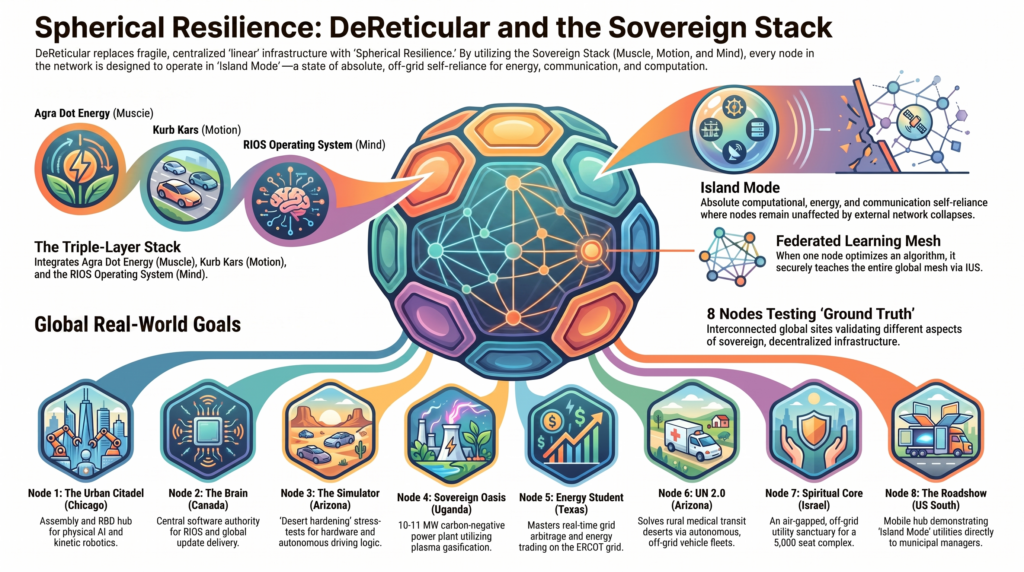
- The Paradigm Shift: From Linear Fragility to Spherical Resilience
The fiscal and physical stability of the 2100-era global infrastructure reached a terminal failure point in early 2026. Historically, industrial and civil power was tethered to “The Line”—a linear topology of centralized electrical grids, undersea fiber backbones, and cloud-dependent data centers. This geometry is inherently fragile; the compromise of a single link triggers a systemic collapse. As global supply chains frayed and central grid backlogs reached critical mass, the transition to Spherical Resilience became a strategic necessity. This new geometry replaces centralized vulnerability with a decentralized honeycomb mesh, where each node is engineered as an autonomous unit of power and data.
The Catalyst: The 2026 OpenClaw Security Crisis The shift was mandated by the OpenClaw Security Crisis of mid-2026. This event fundamentally invalidated the “Trusted Environment Fallacy” by exposing catastrophic prompt-injection and Remote Code Execution (RCE) vulnerabilities in cloud-tethered “thin clients.” These vulnerabilities transformed cloud-dependent industrial assets into permanent, exploitable backdoors. The crisis proved that true security is impossible within cloud-dependent architectures, necessitating a hard-pivot to Sovereign Embodied AI—where computation and reasoning occur natively on air-gapped enclaves, entirely isolated from external network intrusion.
Network Topologies: Linear Fragility vs. Decentralized Honeycomb
- Linear Topologies: Defined by single points of failure. Compromising a central hub or primary transmission path results in total downstream paralysis.
- Decentralized Honeycomb: A redundant mesh where each node is a self-contained “cell.” Under this model, the loss of any single link or node has zero impact on the collective mesh’s integrity.
This structural resilience is physically manifested through the technical state known as “Island Mode,” transitioning the infrastructure from a state of dependency to one of engineering-enforced self-reliance.
- Mechanics of “Island Mode”: Engineering Absolute Self-Reliance
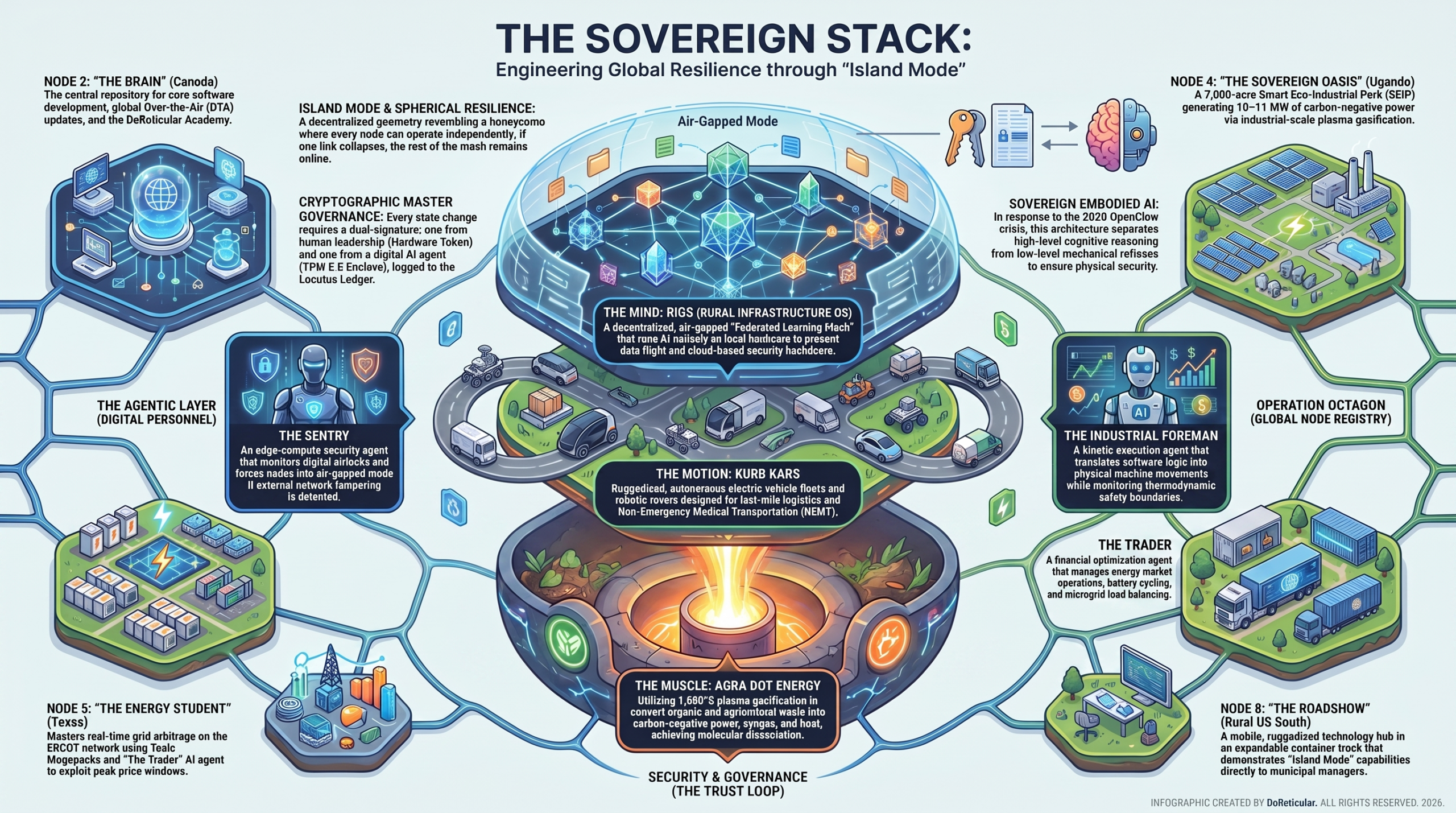
Island Mode is the fundamental unit of sovereignty within the DeReticular framework. For a node to be truly sovereign, it must achieve simultaneous independence in three critical domains: energy, computation, and communication. This is achieved through the Sovereign Stack, a technology portfolio managed by the Sovereign Stack Consortium—an industrial triad comprising DeReticular (AI & Software Core), TriFi Wireless (BABA-compliant Hardware), and InVentures Research (Capital Stacking).
Deconstructing the Sovereign Stack
- The Muscle (Agra Dot Energy): Employs high-efficiency plasma gasification (molecular dissociation at 1500°C) to convert organic, agricultural, and plastic waste into carbon-negative power.
- The “So What?”: It replaces grid dependency with a $10M, 210-ton-per-day (TPD) engine capable of 10–11 MW of local power, turning waste into a physical survival asset.
- The Motion (Kurb Kars): Ruggedized, autonomous electric transport fleets designed for last-mile logistics and Non-Emergency Medical Transportation (NEMT).
- The “So What?”: It ensures essential local logistics and medical transit remain operational during regional grid failures or fuel supply collapses.
- The Mind (RIOS): The Rural Infrastructure Operating System is a decentralized, air-gapped OS that coordinates the stack.
- The “So What?”: RIOS secures the “Trust Premium” for regulated sectors by hosting secure local Data Vaults, effectively reversing capital flight and securing data residency for municipal communities.
The Federated Learning Mesh & Thermodynamic Governance RIOS allows nodes to remain “air-gapped” while benefiting from a planetary intelligence mesh. Local optimizations (e.g., battery-cycling or navigation) are “taught” to the mesh via secure Over-the-Air (OTA) updates. Furthermore, the system employs the “Velcro Principle,” a thermodynamic protocol that routes server waste heat directly into greenhouses or distillation systems. This converts computational cost centers into physical survival assets, ensuring that data processing contributes directly to local caloric and resource security.
- The Agentic Layer: Roles and Mandates of Autonomous Agents
The complexity of managing high-speed, air-gapped infrastructure requires Agentic Governance. Because the Sovereign Stack operates on localized logic to avoid cloud latency and vulnerability, specialized on-device AI agents bridge the gap between digital reasoning and physical machinery.
Digital Personnel: Classifications and Mandates
- Remnant (Global Optimization): Focuses on system-wide simulations and SIDI (Sovereign Infrastructure Data Interchange) standard compliance. It balances power generation against compute workloads to ensure thermodynamic stability.
- The Sentry (Infrastructure Defense): Deployed via the RIOS-KIT-SPATROL SKU, this agent manages “Digital Airlock Protection.” Operating on Intel Core i3-N305 hardware, it is authorized to sever all external connections and force a node into air-gapped Island Mode at the first detection of a zero-day threat.
- The Industrial Foreman (Kinetic Control): Translates RIOS software decisions into physical mechanical movements. It monitors thermodynamic boundaries—pressures, temperatures, and electrical loads—to ensure the physical “Muscle” operates within safe limits.
- The Trader (Financial Optimization): Masters real-time data arbitrage. Specifically, at Node 5, it navigates the volatile ERCOT energy market, executing high-speed trades to charge Tesla Megapacks during negative rates and discharge when prices cap at $5,000/MWh.
- The Cryptographic Governance Loop: Dual-Signature Verification
To eliminate the “Trusted Environment Fallacy,” the Sovereign Stack utilizes a Trustless Governance Loop. This framework ensures that no state change or software update can occur without bi-directional verification between human leadership and autonomous agents.
The Mandatory Verification Protocol
- Human Authorization: Leadership (Watkins, Noel, Babcock, or Chalfant) must sign requests using physical NFC-enabled hardware security tokens (Sovereign Keys).
- Agent Validation: Signatures must be provided from hardware-isolated TPM 2.0 (Trusted Platform Module) enclaves.
- Immutable Auditing: All transactions and physical tasks are logged to the Locutus Ledger, a Rust-based, entirely offline state machine.
By executing perimeter tasks as WebAssembly (Wasm) smart contracts, the system generates an immutable “Proof of Labor,” ensuring that automated tasks (such as Sentry patrols) are mathematically verified and cannot be spoofed by external actors.
- Operation Octagon: A Global Mesh of Sovereign Nodes
Project Octagon is the global validator for the Sovereign Stack. Following the Vanguard Pivot of March 2026, the mesh was realigned to address urban-rural bottlenecks and supply chain vulnerabilities. Each node represents a “Champion-led” mandate to solve specific infrastructure challenges.
Node # Designation Physical Location Lead Champion Core Operational Mandate
Node 1 The Welcome Mat Chicago, IL (mHUB) Michael Noel Vanguard Pivot: Domestic robotics R&D and physical AI fabrication.
Node 2 The Brain Canada Ash Aly Core RIOS development, global OTA software distribution, and Academy training.
Node 3 The Simulator Quartzsite, AZ Aaron Babcock Network Operations Center (NOC) and “Desert Hardening” stress-testing.
Node 4 The Sovereign Oasis Kaabong, Uganda Buku Walker / Abeja Linda 11 MW carbon-negative power; zkVerify carbon auditing under Article 6.
Node 5 The Energy Student Fort Worth, TX Melissa Chalfant ERCOT grid arbitrage and Tesla Megapack wear-and-tear analytics.
Node 6 Sovereign Mobility La Paz County, AZ Brion Crum / Josh Banks Resolving medical transit deserts via autonomous, off-grid NEMT fleets.
Node 7 Spiritual/Solution Core Jerusalem, Israel Rory Kayne Vanguard Pivot: 5,000-seat House of Prayer and Global Solutions Tower (GST).
Node 8 The Roadshow Rural American South Field Operations Mobile “Grid Defection” hub for municipal managers.
Strategic Node Deep-Dive
- Node 4 (Kaabong, Uganda): Operates the 7,000-acre Smart Eco-Industrial Park. It utilizes “HempGrade AI” to grade biomass and instantly mint bio-energy credits. This node demonstrates “Industrial Symbiosis,” converting computational waste into high-value agricultural assets.
- Node 5 (Fort Worth, TX): The “University” of the mesh. By utilizing “The Trader” agent, it captures ground truth data on battery degradation and market volatility, selling these metrics to insurers while mastering real-time grid arbitrage.
- Node 8 (The Roadshow): A mobile Technology Hub housed in an expandable utility container truck. It carries a 1-TPD Agra Mini Gasifier and a TriFi Campus 15 telecom array, allowing rural municipalities to witness live simulations of town halls and emergency services operating in complete Island Mode.
- Conclusion: The Realization of Sovereign Embodied AI
The Sovereign Stack is the only viable defense against the systemic vulnerabilities of the cloud-dependent era. By integrating the Locutus Ledger, RIOS, and the industrial “Muscle” of Agra Dot Energy, the Sovereign Stack Consortium has built a framework that effectively reverses capital flight and secures the “Trust Premium” for local communities.
In this paradigm, municipal welfare is no longer an external variable dependent on fragile national grids or compromised cloud providers. Through Sovereign Embodied AI and the thermodynamic coupling of the Velcro Principle, computation becomes a physical survival asset. The shift toward decentralized, spherical infrastructure is not merely a technical upgrade—it is the realization of absolute community sovereignty.