Industrial Operational Blueprint: The Continuous 40-Acre Daily Harvest Pipeline
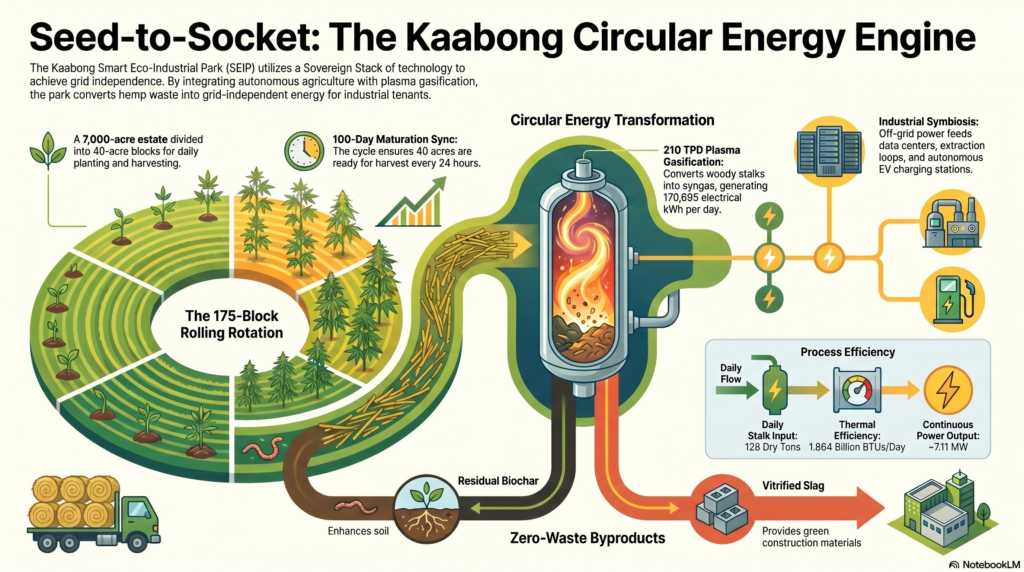
1. The Continuous Rolling Rotation Model
Context and Strategic Importance
In the pursuit of Spherical Resilience, the 175-block rotational model is the architectural foundation of the Node 4 ecosystem. This model eliminates the seasonal peaks and troughs inherent in traditional bulk harvesting, transforming highly variable agricultural yield into a consistent industrial utility feed. By maintaining a perpetual harvest cycle, we maximize the utilization of downstream assets—specifically the plasma gasifier and extraction loops—ensuring they operate as high-uptime industrial engines rather than seasonal processing centers.
Operational Scale-Up Status: Phase III Legacy Architecture
As of May 2026, it is critical to note that while the technology stack is fully validated, the Node 4 site has been re-scoped as a “Sovereign Oasis” (off-grid hospitality and modular stack validation) following the March 2026 Vanguard Pivot. This document serves as the Phase III Legacy Architecture Blueprint, detailing the requirements for the 7,000-acre industrial scale-up currently held as a designed but inactive end-state.
Deck
https://academy.dereticular.com/wp-content/uploads/2026/06/The_Kaabong_Perpetual_Engine.pdf
Operational Cadence and Lignification Management
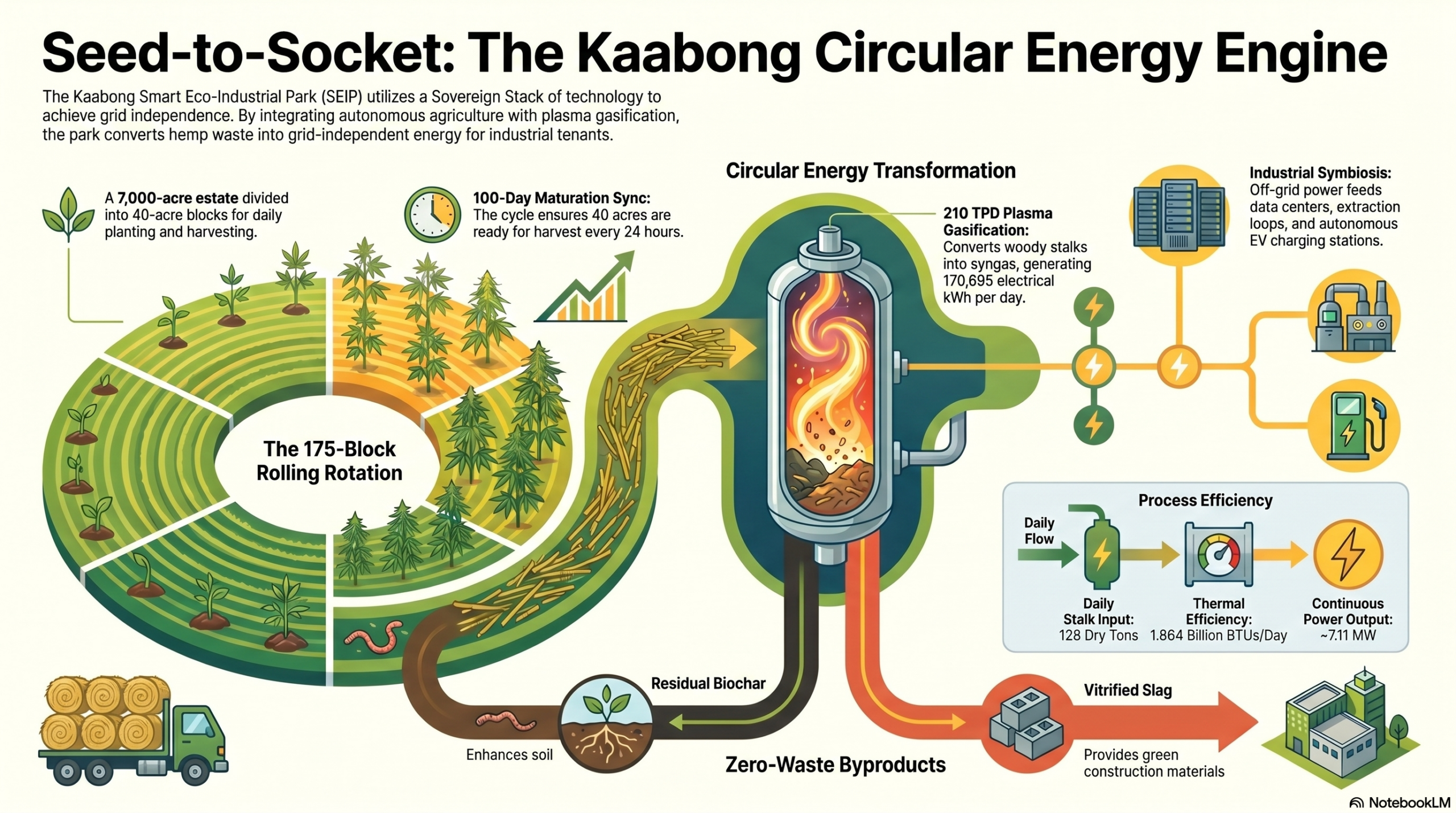
The “Rotation Math” divides the 7,000-acre master estate into 175 operational blocks of 40 acres each. Based on a 100-day maturation cycle, the fleet executes a synchronized cadence where 40 acres are sown while another 40 acres are harvested daily. Beyond volume consistency, this 100-day window is a critical engineering constraint: harvesting at this specific physiological stage prevents advanced lignification. If harvest is delayed, the stalks become excessively brittle and fibrous, creating catastrophic friction loads on the gasifier’s feed-screw delivery system.
Daily Yield Modeling
The following table models the daily outputs across three primary cultivation scenarios, calibrated to industrial and thermal demand.
| Parameter | Scenario A: High-Density Fiber | Scenario B: Low-Density Floral | Scenario C: Dual-Purpose |
| Plant Population (per acre) | 1.0M – 1.2M | 1,500 – 2,500 | 150,000 – 200,000 |
| Total Dry Yield (per acre) | 4.0 tons | 1.25 tons | 2.5 tons |
| Stalk Fraction (Dry) | 80% (3.2 tons/ac) | 30% (0.375 tons/ac) | 70% (1.75 tons/ac) |
| Foliage Fraction (Dry) | 20% (0.8 tons/ac) | 70% (0.875 tons/ac) | 30% (0.75 tons/ac) |
| Stalks / Day (40 acres) | 128 Dry Tons | 15 Dry Tons | 70 Dry Tons |
| Wet Leaf / Day (40 acres) | 106.8 Wet Tons | 116.8 Wet Tons | 100.0 Wet Tons |
Strategic Impact
Scenario A provides 128 dry tons of stalks per day, which equates to approximately 213 wet tons at 40% moisture. This output provides 101% of the intake capacity for the 210 Tons Per Day (TPD) plasma gasifier, allowing the energy plant to operate at a steady 61% load. This precise match ensures continuous baseload power for the Node 4 microgrid and digital infrastructure.
Connective Tissue
This thermodynamic viability is predicated entirely on the mechanical consistency and precision of the autonomous harvest fleet described in Section 2.
——————————————————————————–
2. Autonomous Agricultural Swarm & Logistical Loops
Context and Strategic Importance
Node 4 shifts the agricultural paradigm from heavy, single-unit tractors to decentralized autonomous swarms. This strategy reduces soil compaction—essential for the deep taproots of industrial hemp—and ensures 24/7 operational uptime. A decentralized fleet ensures that a single mechanical failure in one unit does not halt the entire daily 40-acre throughput.
The Seeding Fleet
Seeding is executed by a Sabanto-retrofitted swarm calibrated for sub-centimeter precision:
- Navigation: Ground-based GPS-RTK base stations provide localized correction signals with sub-centimeter lateral accuracy.
- Fleet: Two 120 HP electric/diesel hybrid utility tractors.
- Precision Depth: Automated hydraulic depth sensors maintain a strict 0.75-inch seeding depth. This is a non-negotiable engineering requirement to ensure uniform emergence across diverse soil profiles and prevent stand failure.
The Dual-Harvest System: Specialized Shearing
Standard disc mowers are strictly prohibited in the Node 4 environment. The high tensile strength of hemp fiber causes rapid friction wrapping around rotating disc spindles, leading to bearing seizures and fire risks.
- Mandated Tooling: The fleet must utilize reciprocating sickle-bar mowers or the KP-4 multi-blade rotary cutter. These implements use a clean shearing motion to cut stalks into uniform lengths (24–36 inches) without wrapping.
- Mechanical Configuration: One Class 7 or 8 rotary combine utilizing a 30-foot draper header for the top 2 feet of foliage, and an under-scythe sickle-bar cutter mounted at 4 inches above the ground for the stalks.
In-Field Logistics and Storage Management
- Autonomous Grain Carts: Utilizing ASI Mobius software for “on-the-move” tandem unloading.
- Kaabong Kars: Unmanned utility vehicles transport wet biomass to extraction within the mandatory 4-hour window.
- Grain Weevil Robots: Within silos, these robots maneuver across the grain using auger propulsion. Their primary “So What?” is leveling the pile to optimize airflow, which is the mechanical defense against the biological risk of fermentation and pocket mold.
Connective Tissue
The reliability of these logistical loops dictates the feedstock quality entering the thermal conversion facility.
——————————————————————————–
3. Thermal Mass Balance: Plasma Gasification & Power Synthesis
Context and Strategic Importance
The 210 TPD Plasma Gasifier is the “engine” of the Smart Eco-Industrial Park (SEIP). By processing residual hemp stalks, the facility achieves off-grid energy sovereignty, shielding the Umoja Compute Core (UCC-1) and other industrial assets from national grid instability.
Thermal Kinetic Modeling
Using Scenario A data (128 dry tons/day), the thermal input is modeled as follows:
- Daily Feedstock: 128 dry tons (256,000 lbs).
- LHV Calibration: 6,500 BTU/lb (based on the input target of 10–15% moisture).
- Gross Daily Thermal Energy: 256,000 lbs × 6,500 BTU/lb = 1.664 Billion BTUs/day.
- Conversion: 1.664 Billion BTUs ≈ 487,700 thermal kWh per 24-hour cycle.
Electrical Output Efficiency and Consumption
Syngas is routed through a combined-cycle gas turbine (35% thermal-to-electrical efficiency):
- Daily Generation: 170,695 electrical kWh/day.
- Continuous Power: 7.11 MW.
- Primary Consumer: This power is primarily dedicated to the UCC-1 Compute Cluster, which draws 1.8 MW of continuous load, with the remainder powering the Node 4 Sovereign Oasis grid and industrial extraction.
Feedstock Engineering and Financial Risk
Gasifier Cost Discrepancy: Note that the DeReticular design targets a $10M CAPEX for the gasifier, significantly below the 27M–82M industry standard. Engineering validation through Phase 2 pilot testing is required to mitigate this risk.
- Mechanical Constraints: Stalks must be chipped to <2 inches.
- Parasitic Load: If stalks are delivered at 40% harvest moisture, significant parasitic energy must be diverted to the drying pipeline to reach the 10–15% moisture safety target.
Connective Tissue
While the stalks provide the energy baseload, the chemical mass balance of the foliage determines the project’s liquid capital recovery.
——————————————————————————–
4. Chemical Mass Balance: Extraction & Downstream Biorefining
Context and Strategic Importance
The wet leaf pipeline is the high-margin core of the biorefinery. Immediate on-site processing is a strategic necessity to prevent the rapid degradation of active cannabinoids in the tropical heat.
Automated Extraction Loop Logistics
The facility utilizes a continuous-flow chilled ethanol extraction loop processing 100 wet tons of foliage per day.
- Input: 100 wet tons (30 dry tons/60,000 lbs).
- Daily Crude Output: 6,000 lbs (~750 gallons) of crude cannabinoid extract.
Downstream Formulation Throughput
The following throughput math relies on a standard concentration of 500 mg active cannabinoids per bottle.
| Metric | Scenario C (Dual-Purpose) | Scenario B (Specialty Floral) |
| Wet Foliage Input | 100 Tons | 116.8 Tons |
| Daily Crude Oil Yield | 6,000 lbs | 8,400 lbs |
| Crude Purity (Active) | 60% | 60% |
| Lotion Output (Bottles/Day) | 3.15 Million | 4.41 Million |
The “So What?” of Biorefining
By capturing the full value chain from soil to Consumer Packaged Goods (CPG), Node 4 captures an 80%+ value increase over raw biomass sales. This transition is what makes the $30M total capital stack viable for recovery within a 2-to-4-year window.
Connective Tissue
The success of this extraction volume is governed by the strict safety and timing constraints of the harvest-to-dryer window.
——————————————————————————–
5. Engineering Constraints & Operational Safety Protocols
Context and Strategic Importance
Industrial hemp is a volatile feedstock. Strict adherence to latency and moisture protocols is the only defense against total batch failure or catastrophic site loss.
The 4-Hour Rule
Under tropical heat, freshly cut foliage undergoes rapid biological degradation. All wet leaves must be processed or reach the drying pipeline within 4 hours of being cut. This requires the RIOS Command Center to synchronize the harvest fleet and the extraction plant in real time.
Silo Safety and Combustion Prevention
Storing 128 tons of stalks per day introduces a severe spontaneous combustion risk.
- Biological Trigger: Excess moisture (>15%) triggers biological fermentation, which spikes internal temperatures in sealed silos.
- Mitigation: We mandate the use of Grain Weevil robots to continuously level the pile and break up crust layers, ensuring the consistent airflow required to prevent thermal runaway.
Mechanical Resilience
- Cutter Standards: Reciprocating sickle-bar mowers are the engineering standard; disc mowers are a disqualifying hazard.
- Bearing Protection: All spinning components on the harvest and processing lines must be equipped with bearing guards and shields to prevent high-tensile fiber wrap.
Connective Tissue
Verification of these complex engineering flows is handled by the digital architecture, which provides the “Oracle” required for institutional finance.
——————————————————————————–
6. Technological Integration: RIOS, Digital Twins, and Yield Verification
Context and Strategic Importance
Attracting capital for off-grid infrastructure requires solving the “Oracle Problem”—the verification of physical production for remote lenders. Node 4’s digital stack provides the mathematically certain transparency needed to bypass traditional banking latencies.
RIOS & OpenClaw Integration
The Rural Infrastructure Operating System (RIOS) acts as the site brain, managing load balancing between the 7.11 MW power plant and the UCC-1 compute cluster while coordinating autonomous fleet telematics.
Cryptographic Yield Verification and Continuous Settlement
Node 4 utilizes Zero-Knowledge (ZK) Proofs and the Locutus Ledger to create Digital Twin Dynamic NFTs for every batch of energy and oil produced.
- The “So What?”: This architecture is designed for 24/7 Continuous Settlement. By bypassing “banking hours” and the friction of traditional international wire clearances, the facility can use verified production as collateral to fund the next agricultural cycle in seconds.
- Legal Enforceability: Under UCC Article 12, these NFTs are classified as Controllable Electronic Records (CERs). Combined with CFTC Letter No. 25-39, institutional lenders can accept these tokenized physical yields as eligible margin collateral.
Conclusion
This blueprint establishes the framework for “Island Mode” industrial sovereignty. By integrating the Rolling Rotation Model with autonomous swarms, plasma gasification, and cryptographic settlement, the Node 4 architecture provides a scalable model for converting equatorial resources into high-value energy, data, and CPG commodities.